

A man awakens with no memory of who he is, where he is, or why he’s here. He’s being ministered to by robotic arms apparently controlled by a computer that keeps asking, “What is your name?” As flashes of memory play out in his mind, he struggles to remember. He asks questions, but all the computer has to say is, “What is your name?”
So at its root, this is a story about identity. The computer won’t let our protagonist do anything else until he remembers his name. At last it comes to him: He’s Ryland Grace, a middle school science teacher with advanced degrees in biology. He’s in a space ship, and his two shipmates are dead.
We gradually learn the backstory as Grace’s memory returns. An organism that thrives at high temperatures is growing on the sun, threatening to destroy the sun and all the planets in its system. Scientists have discovered only one star in the universe that is not infected with the microbe, and Grace has been sent off to figure out why that star isn’t infected and to send the information back to earth.
It’s science fiction. Don’t parse the science too much. Just accept the novel’s premise and accompany Grace on his journey of discovery. I can’t explain any more of the plot because I have a strict policy of avoiding spoilers.
Told with empathy and lots of humor, Project Hail Mary is a feel-good story of self-discovery and personal growth. If you persevere, I predict you will like, like, like it.
The novel received the following literary awards: Hugo Award Nominee for Best Novel (2022), Geffen Award for Best Translated Science Fiction Book (2023), Audie Award for Best Audiobook and Science Fiction (2022), Lincoln Award Nominee (2024), Nutmeg Book Award for High School (2025), Goodreads Choice Award for Science Fiction (2021), Green Mountain Book Award (2023), RUSA CODES Reading List Nominee for Science Fiction (2022).
© 2026 by Mary Daniels Brown
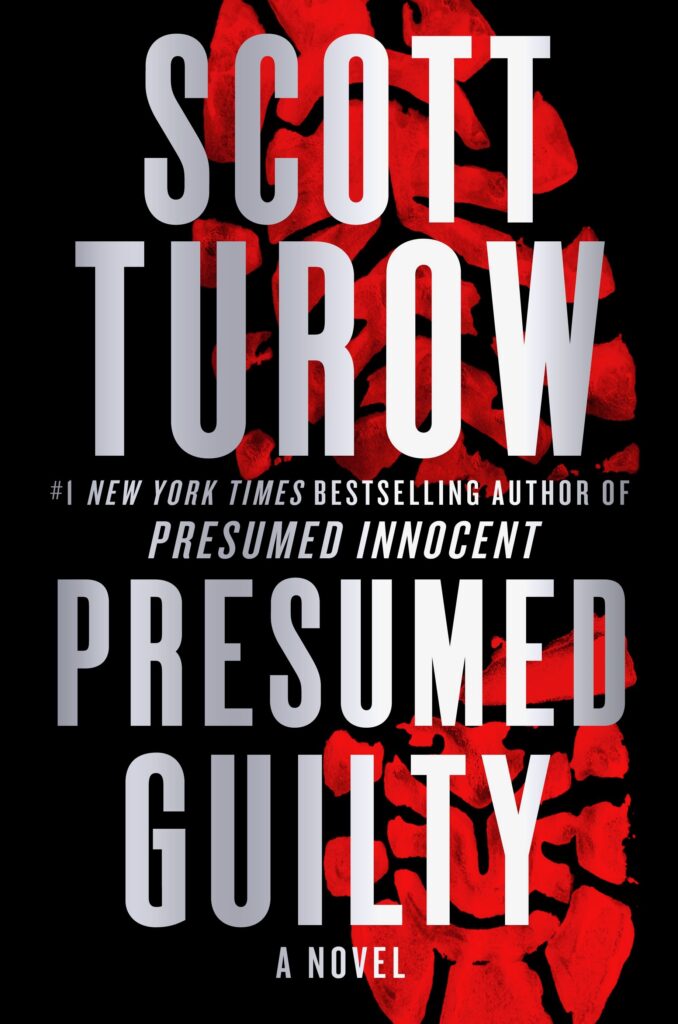
Presumed Guilty by Scott Turow
- Grand Central Publishing, 2025
- Narrated by Grover Gardner
Attorney Scott Turow burst upon the literary scene with his 1987 novel Presumed Innocent. In that novel, Rusty Sabich, then a county prosecutor, is charged with murder and put on trial. As the title Presumed Guilty suggests, this novel brings Rusty Sabich full circle when he returns to the courtroom as a defense attorney.
Now in his 70s, Rusty shares a home with Bea, a woman he hopes to marry soon, and her adopted son, Aaron. Bea and her former husband, who are both white, adopted Aaron, who is Black, as an infant. When Aaron’s long-time, on-again-off-again white girlfriend, Mae, disappears and is then found murdered, Aaron is arrested and put on trial for first degree murder.
In a predominantly white jurisdiction, Bea convinces Rusty to return to the courtroom as Aaron’s best hope for a fair and competent defense. But Rusty knows he and Aaron face an uphill battle within a community where Aaron is already presumed guilty.
This big book (544 pages in the hardcover edition) is an Edgar Award Nominee for Best Novel (2026).
© 2026 by Mary Daniels Brown
The Friday Afternoon Club: A Family Memoir by Griffin Dunne
- Penguin Audio, 2024
- Narrated by Griffin Dunne
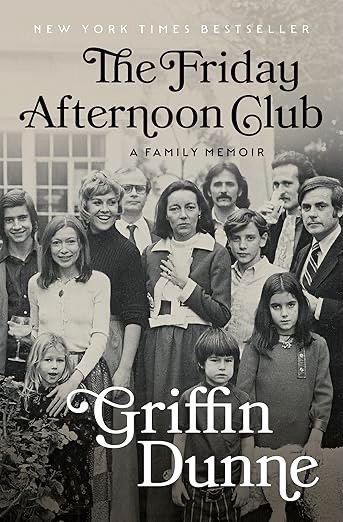
I was drawn to this book because of the family Griffin Dunne refers to in the subtitle. Griffin is the son of film producer and prolific writer of both fiction and nonfiction, Dominick Dunne, whose work frequently appeared in Vanity Fair. In 1982, Griffin’s sister, Dominique Dunne, a 22-year-old actor who had just had her first big performance in the movie Poltergeist, was murdered by her ex-boyfriend. The trial became a spectacle, and after it ended Dominick Dunne often appeared on television talking about crime.
Dominick Dunne was also the brother of John Gregory Dunne, a writer who married Joan Didion, making her an aunt by marriage to Griffin. Both the Dunne brothers and Joan Didion all began their careers as writers and producers in Hollywood, and their associations with various Hollywood figures continued throughout their lives. Near the beginning of his family memoir Griffin Dunne describes being saved from drowning at the age of eight by Sean Connery. As a young man Griffin was a close friend and roommate with Carrie Fisher before Star Wars made her famous.
Griffin Dunne writes quite unaffectedly about growing up in such a famous family. I enjoyed his book, even if I had hoped for a few more anecdotes about his aunt, Joan Didion.
© 2026 by Mary Daniels Brown
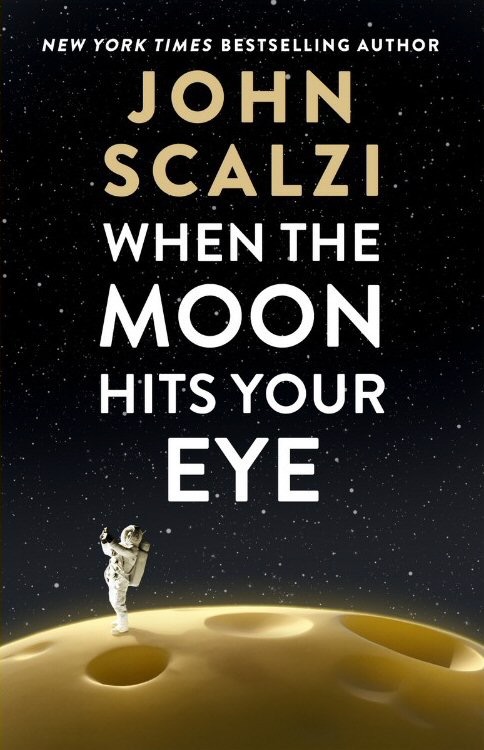
When the Moon Hits Your Eye by John Scalzi
- Audible Studios, 2025
- Narrated by Wil Wheaton
Long, long ago I read somewhere that a novel begins to take shape when someone asks, “What if . . .?” Prolific science fiction writer John Scalzi presumably asked “What if the moon actually turned into cheese?” And here we are, with When the Moon Hits Your Eye.
Through a complete lunar cycle, from the new moon through to the full moon, people on earth wonder at the cheese moon and what it means. First are the politicians from whom the public expects explanations and plans of action. Next come the scientists, those in charge of NASA and heads of university astronomy departments, whom the politicians consult. They all feel the necessity to talk, even though they have no idea what they’re talking about. Soon we hear reactions of the regular folks, from teenagers to three retired men having their weekly breakfast together in the local diner.
John Scalzi can be one of the funniest contemporary American writers, and all this is quite entertaining. But as the month wears on, just when the humor begins to cloy, the tone softens. Once astronomers have determined that a giant cheese asteroid will destroy the earth in two years and three months, give or take two weeks, we meet real people facing real situations; a musician with a terminal cancer diagnosis reunites with the first love of his life, the woman who inspired all the great songs; a midwestern pastor facing his own crisis of faith finds a way to comfort his parishioners as they face the impending existential dread.
But Scalzi is generally not a dreadful guy, so don’t be afraid to pick up this latest book. I listened to the audiobook, with Wil Wheaton narrating all the voices, and found it equally entertaining and thought provoking.
© 2026 by Mary Daniels Brown
