
‘He left the world in ruins’: the author who defied the Taliban and burning tyres to tell Alexander the Great’s epic story
The story of Alexander the Great might be more than 2,000 years old, but it seems timely that a new biography of the ancient ruler won the Baillie Gifford prize for nonfiction just as President Trump took a battering in the US midterms. “This is a moment,” says its author Edmund Richardson, “where people are finding that there are limits to what unlimited wealth and power can do, and that humanity catches up with you, whether you like it or not. Alexander wants to transform the world – and he leaves it in ruins.”
The Secret Lives of Objects
“ARTIFACTS author Natalie Lemle on ancient relics and the stories they contain”
Novelist and art historian Thomas Schlesser talks with Natalie Lemle about her debut novel, Artifacts.
Here, Lemle explains the appeal of archaeological objects:
we want to dig in order to understand. We want to understand how people lived before us, what they did with the things they possessed or shared—maybe because those things give us clues about our own daily life, or help us understand something about the through-line between human beings.
“Art helps us understand ourselves because we see our story, and we feel it reflected back to us,” Lemle says.
The Liberated Women of Sigrid Nunez’s New York
“The best stories in It Will Come Back to You could only take place in a big city, where women escape social conventions.”
Maggie Doherty discusses the stories in It Will Come Back to You, a recent collection of 13 previously published stories by Sigrid Nunez, now 75 years old.
the collection explores the writer’s long-standing preoccupations with the clashing of social classes, the consolations of the intellect, and the messy romantic lives of women who love men. The women at the center of these stories—with few exceptions, the stories are told from a woman’s point of view—are, for the most part, intelligent, unmarried, and unsentimental about aging but afraid of death itself. Some are writers; others merely have novelistic imaginations. All are inclined to speculate about their acquaintances and to fill memory’s gaps with their own inventions.
“These stories, spanning Nunez’s career, capture the ways the city can shape life’s different phases,” Doherty writes.
How the brain learns to read is an evolutionary mystery—a new study offers clues
“Reading hasn’t been around for long, evolutionarily speaking. Instead, the brain recruits systems evolved for other purposes”
In Scientific American, Mikael Roll, professor of phonetics at Lund University in Sweden, reports on recent results of a study on the links between brain structure and reading skill.
Roll discovered “there is not only one way to learn to read or even only one way to read.” His findings “could also explain how people who are deaf, blind or have dyslexia learn to read in remarkably different ways.”
What Anne of Green Gables Reveals About White Girlhood
“Anne of Green Gables is one of the most enduringly popular Anglo-American girlhood novels,” Sarah Mesle proclaims in this excerpt from Tangled: Seven Iconic Moments in White Women’s Hair and What They Tell Us About Power, Pleasure, and Complicity.
But wait. Isn’t Anne of Green Gables set in Canada? Yes, Mesle concedes, “but its publication and marketing history are entirely American.” Since Revolutionary times, Mesle continues, Americans have worked hard to develop a national identity of stories that focus on liberty and justice while ignoring tales “of cruelty, displacement, selfishness, [and] violence.” And that’s why Mesle incorporates Anne of Green Gables into the pantheon of popular American fictions.
Mesle explains at length how Anne of Green Gables has continued to represent a nostalgic, conservative element in the United States’ vision of itself. Be sure to look at the comments after the article that reclaim L.M. Montgomery and Anne Shirley as distinctly Canadian.
How to rediscover your purpose later in life
“You don’t have to ‘reinvent’ yourself to live happily after 60. There’s a better approach grounded in lifespan psychology”
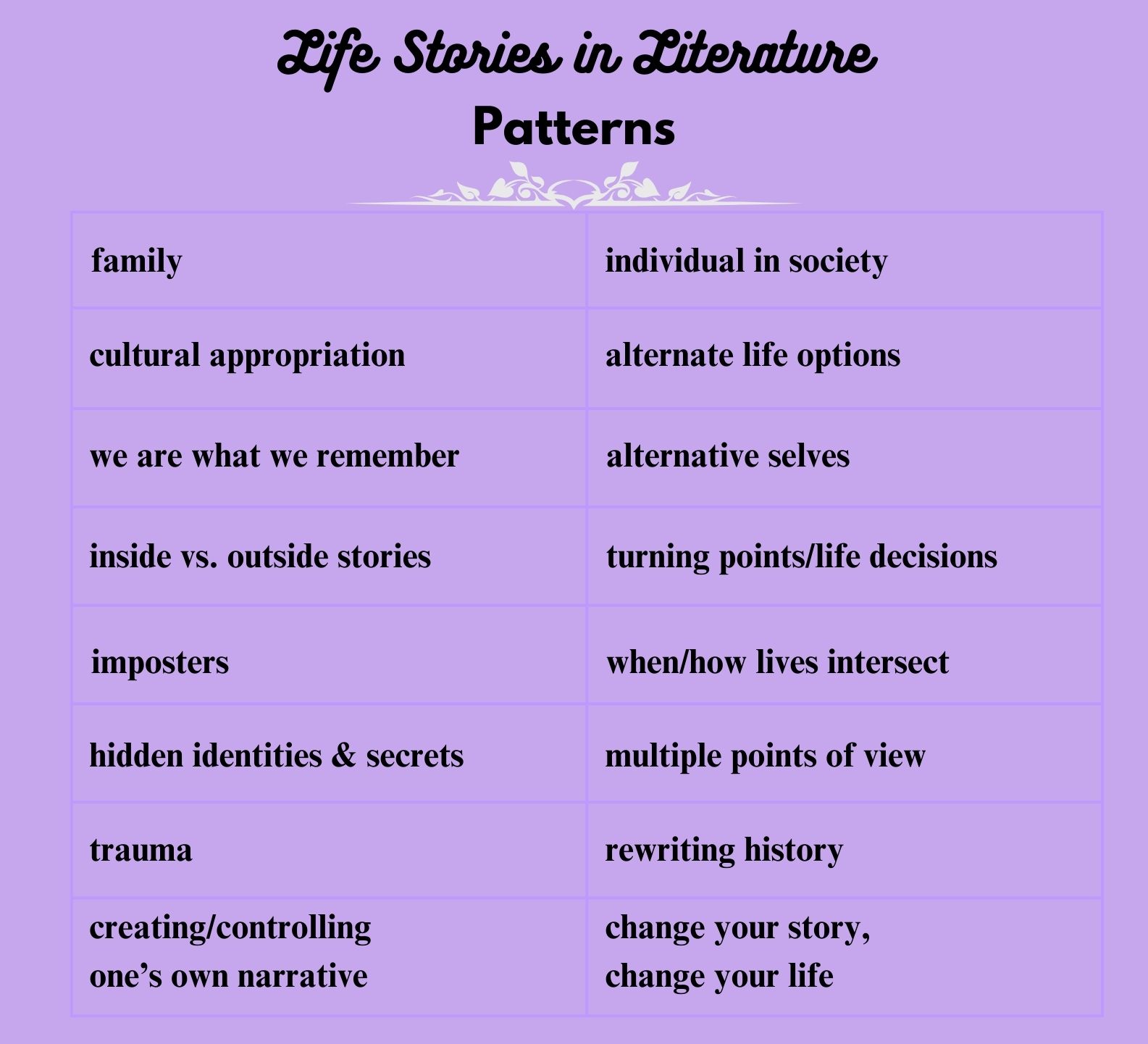
Two of the underlying patterns of Life Stories in Literature are finding meaning or purpose in life and changing one’s life by changing one’s story. But psychologist Denise Taylor reports that many of her older clients report a sense of unease or a feeling of flatness, despite efforts to remain active and engaged with life.
Taylor recommends thinking of this period of life as a time not of reinvention, but, rather, of reorientation. “This approach acknowledges that your direction of growth is changing, becoming more selective and reflective,” she explains.
This article offers five key points to help with this transition.
Why Is Every Book ‘Gothic’ Now?
“Candlelit corridors, eerie old portraits and other tropes aren’t exclusive to horror and romance this year — they’re everywhere.”
Gothic motifs have spread across the book world this year, writes Deirdre Coyle. “The Gothic label, once applied primarily to horror and dark romance, has been used to describe space operas, literary works and fantastical hybrids of all kinds.”
Most of the scholars Coyle interviewed emphasize that gothic literature often flourishes during periods of societal anxiety and upheaval:
Interest in the Gothic often surges during periods of social anxiety and political turmoil, explained Xavier Aldana Reyes, a researcher at the Manchester Centre for Gothic Studies — which perhaps explains its popularity during the Vietnam era and the final years of the 20th century.
Reyes adds that now, issues such as climate change, pandemics, wars, and political upheavals seem overwhelming. “The Gothic provides a safe space through which to process our real-world fears.”
© 2026 by Mary Daniels Brown
