

Related Post:
Week 2 (November 9-15) – Nonfiction Journeys
Hosted by Frances at Volatile Rune.
This week choose a book that reflects a journey for its author/protagonist or for the reader or both. This can be a physical journey, an emotional, psychological or spiritual journey or a combination of these. Any nonfiction title that leaves its author/protagonist and/or reader in a different place at the end from the start point is good for this challenge.
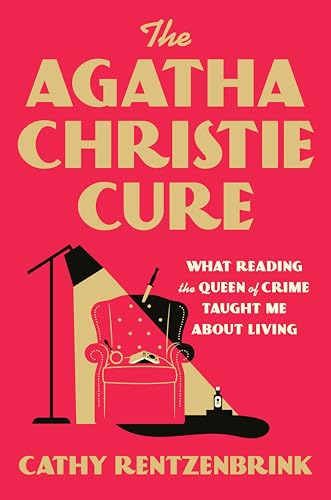
The Agatha Christie Cure: What Reading the Queen of Crime Taught Me About Life by Cathy Rentzenbrink
- Viking, 2026
- Hardcover, 352 pages
- ISBN 978-0-593-83530-2
The subtitle is what drew me to this book. This month I’m primarily looking at books in which people consider how reading—particularly reading fiction—has been important in or somehow influenced their lives. The subtitle put this book at the top of my list.
Cathy Rentzenbrink fell in love with the works of Agatha Christie at age nine, when her grandmother introduced her to Christie’s crime novels. Forty years later, Rentzenbrink found herself in a state of anxiety and depression: her marriage was floundering, her young son’s severe dyslexia was causing major problems at school, and she faced a writer’s worst nightmare, writer’s block.
That’s when she decided she needed a project to help her work through her pain and despair. So she turned once again to Agatha Christie, with a focus on the period of 11 days in 1926 when Christie had disappeared. Her car was found abandoned, but no one knew where she was. When she was finally found registered at a hotel under a false name, Christie claimed amnesia: She said she couldn’t remember who she was or how she got there. Despite much speculation, this incident has never been convincingly explained.
Rentzenbrink decided to read through all of Christie’s fiction and her autobiography to try to understand why she had disappeared without a credible explanation. Rentzenbrink hoped that if she could understand Christie’s situation, she might also be able to cope with her own.
To understand everything that came afterwards, I realised, I did need to pay attention not only to those eleven days in December but to all of 1926. And then I began to feel that Agatha herself was leading me there. Because while she might not have talked about it directly, there were so many clues scattered through the books, it was almost as though she’d been waiting for an attentive reader to piece them all together. And as my own life derailed, and as I increasingly wished that I, too, could run away to Harrogate, I felt like she had something to teach me about disappointment and heartbreak, about grief and recovery, and about the very nature of making mistakes. (p. 6)
As Rentzenbrink worked through her rereading of Christie’s novels, she realized that Christie must have been going through a life crisis similar to her own: “The real story of 1926 is a simple one of grief, heartbreak, and despair. Those feelings nearly killed her, but they didn’t. And that’s how hers became a story of recovery and survival” (p. 277).
Finally, Cathy Rentzenbrink was able to make peace with herself and her life by following Agatha Christie’s example:
Agatha helped me to not to run away [sic] and then—the more I read—helped me to be properly present. I don’t feel like I’m playing or pretending any more. I write. I mother. I love. I make mistakes and get over them. I grieve. I flinch. I laugh and cry, often at the same time. I survive. (p. 306)
Bonus Note
The Mysterious Case of the Real Agatha Christie
“At the British Library, visitors are invited to sift through a lifetime of clues to uncover the woman behind the world’s best-selling crime novels.”
© 2026 by Mary Daniels Brown
