
The best book I read this month is Buckeye by Patrick Ryan.
Here are the other two.

Nash Falls by David Baldacci
- Hachette Audio, 2025
- Narrated by MacLeod Andrews, Christine Lakin, Larry Herron, Shiromi Arserio, and Will Collyer
When you’ve been in the writing business as long as I have, the one thing you need to constantly search for are stories that will challenge you as a novelist . . . This is probably the most intense and gut-wrenching novel I’ve ever written.
I’m always interested when writers explain the need to challenge themselves. In the article quoted above David Baldacci explains the problem he set for himself in this novel:
Nash Falls begins with a question at its core: what would you do if your normal, everyday life was suddenly destroyed by forces outside of your control, or even your comprehension? What if you were the wrong person at the wrong time, for all the wrong reasons?
To address his self-imposed challenge, Baldacci creates the character Walter Nash, “a normal hardworking businessman who is as far from the world of intrigue and murder as it’s possible to be.” Nash has a wife and a daughter who’s just graduated from high school, and he’s made a comfortable life for his family through wise investments for the high-stakes financial firm that employs him.
Nash’s problems begin when an FBI agent shows up in his back yard late one night. The agent explains that the government has long been investigating the firm where Nash works for involvement with a high-level global organized crime organization. Every time the feds line up an internal whistleblower, that person ends up dead. Is Nash willing to be their next mole? Nash himself has no criminal entanglements, but, the agent tells him, if he doesn’t help them and they do manage to bring the firm down, Nash might end up guilty, by association, of some very significant crimes. His cooperation will ensure his immunity from any related prosecution.
Feeling damned if he does and damned if he doesn’t, Nash agrees to cooperate. But he has no idea how huge, and hugely powerful, the organized crime network is. When Nash’s daughter disappears and then releases a video accusing him of sexual abuse, he becomes a fugitive and realizes how far in over his head he is.
To fight back, Nash has to slough off every shred of human decency he ever had. “What I had to subtract from Nash,” Baldacci writes, “which I’ve never really had to take from my other characters, was his humanity. To rob the man of what made him, him. . . . I had to make you both root for Nash and feel saddened for him, for having to become the Hulk when all he ever wanted to be was not the Hulk.”
I’m not rating Nash Falls because Baldacci intends it to be read in conjunction with the sequel, Hope Rises, due for publication in April 2026. I’m eager to see how Baldacci has met the challenge of writing Walter Nash’s life story:
I always have a goal with each of my characters, and the goal for Nash was much like my other novels: finding the truth and imposing accountability. I think readers seek out my books because in the pages they can discover results they can’t often find in real life. I would much prefer that justice and accountability happen in real life with greater frequency than they sometimes do. But finding it in these pages has worth too. Because then, suddenly, people start clamoring for it more in the real world.
That’s how fiction works.
© 2025 by Mary Daniels Brown

The Secret of Secrets by Dan Brown
- Doubleday, 2025
- Kindle ed., 688 pages
- ISBN 978-0-38-554692-8
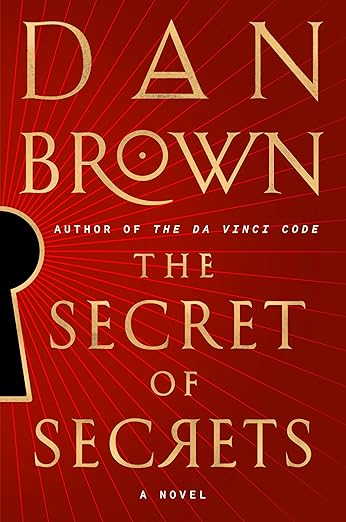
You can be pretty sure what you’re going to get with a Dan Brown novel: rip-roarin’, nonstop plot with just enough characterization for peoples’ actions to make sense, with some esoteric concepts and an atmospheric, history-laden setting to spice things up.
Harvard symbologist Robert Langdon has settled into a comfortable romantic relationship with Katherine Solomon, a noetic scientist (someone who studies consciousness). Langdon has managed to wrangle some free time to spend with Solomon in Prague, where she’s presenting a lecture detailing some of her latest research results. The lecture is a prelude to her soon-to-be-published book that she claims will change centuries of established belief in how we think about the human mind.
Then the manuscript for Solomon’s book inexplicably disappears from the publisher’s computer system, and then Solomon herself disappears. People start dying, and soon high-level investigators are after Langdon. In typical Dan Brown fashion, the situation escalates quickly; it is further complicated by the appearance of a mysterious character straight out of the ancient mythological history of Prague itself.
My only complaint about this novel is that it should have received a final read-through by a good copy editor. This is a problem I’ve been seeing more and more frequently over the last several years since publishers cut copy editors from their staff to save money. In this case, there were several instances of redundancy of explanatory material. It looked as if the author had originally explained something in one place, then later decided to move the explanation elsewhere in the story without going back and deleting the explanation from its original placement. Mistakes like this are now frequent, obvious—and totally unnecessary. Just hire a professional copy editor.
I saved this novel to occupy me on a long airplane flight, and it served that function admirably (except for those irritations caused by inadequate editing).
© 2025 by Mary Daniels Brown
